Understanding Forest Wildlife Watching in United States Forest Landscapes
United States forest landscapes encompass more than one hundred fifty national forests administered by the U.S. Forest Service, alongside state forests, tribal woodlands, Bureau of Land Management parcels, and forested units within the National Park System. These lands span temperate rainforests of the Pacific Northwest, longleaf pine savannas of the Southeast, aspen groves of the Rocky Mountains, maple-beech hardwoods of the Northeast, and saguaro-studded sky islands of the Southwest. Educational travelers researching wildlife observation in forest ecosystems benefit from treating forests as dynamic ecosystems managed for multiple purposes rather than as uniform wilderness backdrops.
Forest travel differs from urban or coastal tourism in ways that affect planning depth. Road networks include paved scenic byways and single-lane dirt tracks closed seasonally by snow gates. Trail maintenance priorities shift after wildfire, blowdown, and budget cycles. Wildlife presence varies by elevation band, season, and recent habitat disturbance. Cell coverage gaps span entire mountain ranges. Educational preparation emphasizes verification through official agency websites, Motor Vehicle Use Maps, trail condition bulletins, and ranger station conversations rather than assumptions drawn from outdated guidebooks or social media posts.
This guide presents general educational information about forest travel across the United States. It does not constitute personalized travel advice, guarantees of trail conditions, wildlife sightings, weather, facility availability, or safety outcomes. Always verify current conditions through official sources such as the U.S. Forest Service, National Park Service, state park agencies, and local ranger districts before departing.
Forest Ecosystems and Wildlife Habitat Zones
Forest ecosystems across the United States support mammals, birds, reptiles, amphibians, and invertebrates adapted to vertical structure from forest floor litter to canopy gaps. Educational wildlife watchers learn elevation zones, forest successional stages, and riparian corridors that concentrate activity without guaranteeing particular species on any schedule.
Old-growth stands with complex structure support different communities than young regenerating forests after harvest or fire. Snags provide nesting cavities for woodpeckers and owls; dense shrub layers follow disturbance before closing again. Seasonal migrants use forests as breeding grounds, winter refugia, or stopover habitat during continental journeys.
Multiple-use forest management means wildlife may encounter active forestry, recreation traffic, and hunting seasons simultaneously. Educational observation respects closures protecting nesting raptors, denning mammals, and calving ungulates during sensitive periods posted on agency maps.
Elevation and Latitudinal Patterns
Appalachian cove forests host salamander diversity and songbird communities distinct from western dry ponderosa pine forests where elk and mule deer browse meadows at dawn. Northern boreal forests support moose and lynx at low densities requiring patience and appropriate habitat scanning rather than roadside certainty.
Sky-island forests in the Southwest isolate populations adapted to monsoon moisture pulses, creating unique watching opportunities for species not found in continuous cordilleras farther north.
- Learn dominant tree species as indirect habitat indicators before expecting specific megafauna.
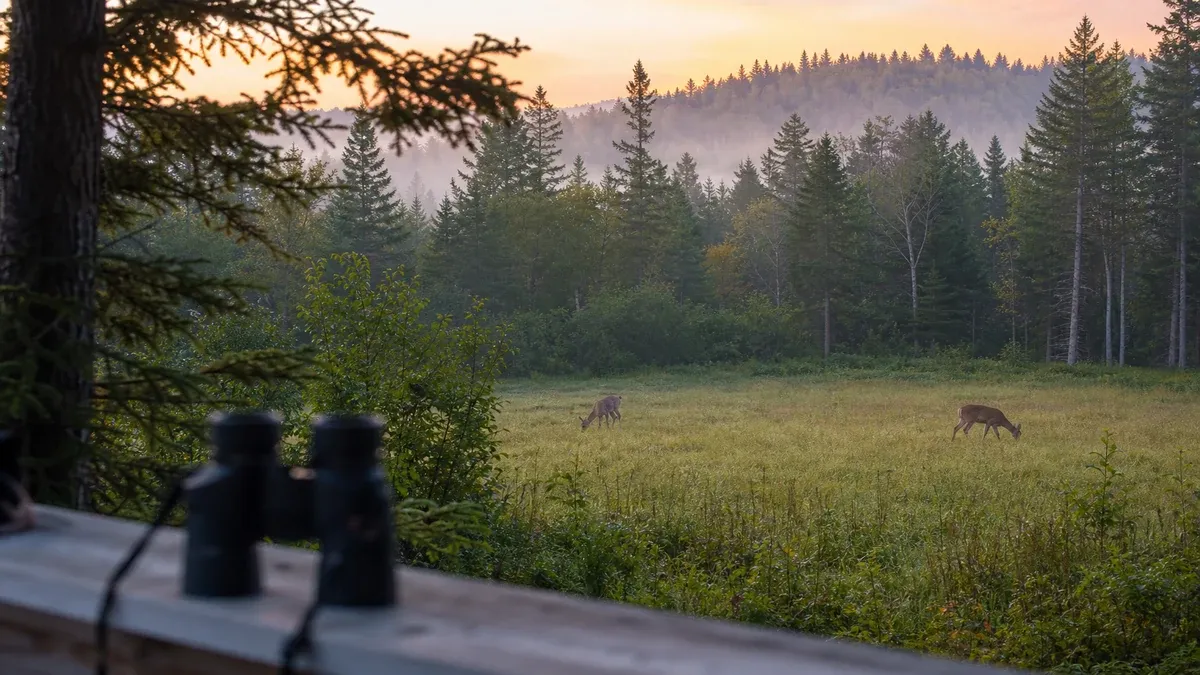
- Carry binoculars with modest magnification; high power magnifies hand shake in dim understory.
- Note dawn and dusk activity increases near water sources visible from designated viewing areas only.
- Review range maps from state fish and wildlife agencies rather than assuming uniform national distribution.
Ethical Viewing Distances and Behavior
Public lands publish viewing distance guidelines varying by species and jurisdiction, often recommending substantial space for large mammals and predators with young. Educational etiquette aligns visitor behavior with conservation goals protecting wildlife from stress, disease transmission, and habituation leading to management removals.
If an animal changes behavior—ears back, raised hackles, aborted feeding, approach toward viewer—observers are too close and should retreat calmly without running unless agency guidance for specific species indicates otherwise during imminent charge scenarios.
Never feed wildlife intentionally or by leaving unattended food at overlooks and picnic areas. Habituated animals later require relocation or euthanasia—a preventable outcome from careless food handling.
Optics, Positioning, and Minimal Disturbance
Binoculars and spotting scopes with tripods enable detailed observation without entering meadows or closing distance. Sit quietly at established viewpoints rather than stalking animals that may flee, wasting energy reserves critical in winter or lactation periods.
Wind direction matters; animals detect human scent upwind. Position observation points downwind when safe and legal without leaving designated trails.
- Turn off phone notification sounds during observation sessions in quiet forest settings.
- Wear neutral clothing reducing visual contrast though camouflage is unnecessary for ethical viewing.
- Avoid playback of recorded calls to lure birds during breeding season when prohibited.
- Report photographers clearly violating closure buffers to rangers promptly and safely.
Species-Specific Considerations in Forest Settings
Black bears occupy forested regions across much of the country; grizzly bears appear in select northern Rocky Mountain and Alaska ecosystems requiring additional safety research through official bear country briefings. Never approach bear cubs or elk calves even when apparently alone; mothers defend aggressively.
Moose tolerate less proximity than deer; give wide berth in riparian willow thickets common in northern forest wetlands. Mountain lions occur at low densities rarely seen but warrant awareness on dawn and dusk trails. Wild hogs in southeastern forests behave unpredictably when cornered.
Forest bird communities include warblers, thrushes, woodpeckers, and raptors seasonally variable. Quiet walking and learning calls from ethical audio resources improve identification without harassing nesting birds.
Dogs, Groups, and Interpreter Roles
Off-leash dogs trigger chase responses from coyotes, wolves where present, and cow moose. Leash laws protect both pets and wildlife on many forest trails. Designate one group member to monitor distance compliance when excitement rises among mixed-age observers.
School and youth groups benefit from pre-trip briefings on quiet voices, stillness, and respectful behavior near nesting areas.
- Do not use drones to approach wildlife; many forests prohibit recreational drone use near sensitive habitats.
- Give moose and elk extra space during rut and calving seasons when aggression increases.
- Practice backing away without running unless charge imminent per agency guidance.
- Educate children using age-appropriate distances rather than fear narratives alone.
Seasonal Wildlife Patterns in Forests
Spring brings breeding activity, migration arrivals, and amphibian movements to vernal pools in eastern forests. Temporary trail closures protect nesting raptors on cliff faces within forested gorges. Summer concentrates food abundance but also insects, heat, and visitor crowds that alter animal activity patterns near popular trails.
Autumn rut seasons produce elk and deer vocalizations audible at dawn in open forest meadows; hunters share many corridors requiring blaze orange visibility where regulations mandate. Winter tracking in snow reveals presence of mammals rarely seen directly, offering educational opportunities without close approach.
Citizen Science and Reporting
Contribute dated observations to official community science platforms when protocols request regional rather than pinpoint coordinates protecting sensitive species. Report injured wildlife to agency hotlines rather than attempting capture; trained responders evaluate intervention necessity.
Share general seasonal patterns in trip reports without geotagging den or nest locations facilitating harassment.
- Participate in Christmas Bird Count and similar programs with local Audubon chapters near forest gateways.
- Document behavior ethically; avoid sharing exact den locations on social media.
- Support habitat connectivity nonprofits preserving migration corridors crossing highways near forests.
- Thank rangers sharing recent wildlife observations at visitor centers when information is public.
Wildlife Safety Without Approaching Animals
Bear spray belongs accessible on belt holsters where permitted and legal, not buried in pack main compartments requiring removal during sudden encounters. Training materials from wildlife agencies demonstrate deployment without guaranteeing outcomes. Food storage and clean camps reduce encounter probabilities in forest campgrounds and backcountry sites.
Snake awareness matters in rocky forest openings and southern pine woods; watch foot placement when stepping over logs. Tick checks after forest walks reduce disease risk; follow CDC guidance on removal techniques.
Educational watchers distinguish between normal animal behavior at distance and signs of illness or habituation requiring professional assessment rather than visitor intervention.
Teaching Observation Ethics to New Forest Visitors
Group leaders model quiet approach, binocular use, and immediate retreat when animals show stress before participants replicate closer approaches seen in undated online media.
Role-playing scenarios help children practice stopping when an adult signals increased wildlife proximity during family forest walks.
- Distribute printed distance guidelines from agency PDFs rather than relying on verbal memory alone.
- Celebrate ethical observations even when charismatic megafauna remain unseen; ecology includes absence data.
- Revisit etiquette discussions after any close call during trips to reinforce learning without blame.
- Never surround wildlife between multiple observers closing a circle.
Connecting Wildlife Learning With Broader Forest Travel
Wildlife observation enriches forest trips when integrated with botany, geology, and cultural history rather than treated as a checklist hunt. Ranger-led walks and nature center programs provide regional context that generic species lists omit.
Museums and fish and wildlife visitor centers near forest gateways offer exhibits on restoration projects, reintroduction history, and management controversies presenting balanced educational framing worth reading critically.
Regional Variation Across Forest Provinces
Southeastern longleaf pine forests support gopher tortoise and red-cockaded woodpecker with specialized habitat needs explained on interpretive trails. Pacific Northwest forests emphasize salmon-linked food webs affecting bear and eagle concentrations seasonally near streams.
Compare expectations when transferring habits from one forest province to another; species assemblages differ more than casual travelers assume.
- Read state fish and wildlife educational PDFs before entering new regions.
- Adjust expectations; wildlife presence is never guaranteed on fixed schedules.
- Combine wildlife learning with watershed and botany for integrated forest ecology understanding.
- Attend evening ranger talks when scheduled at developed forest recreation areas.